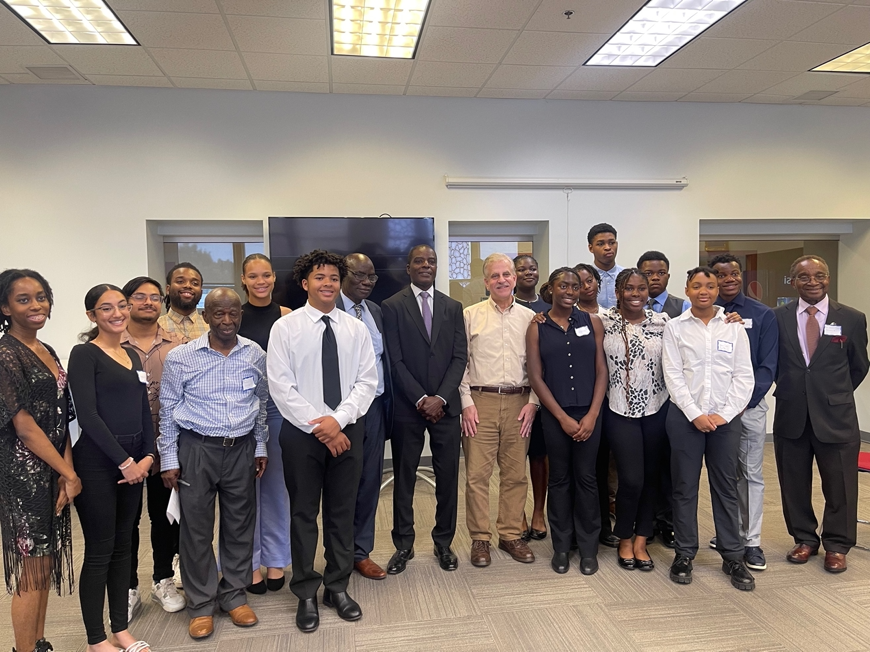
Welcome to the home of CESaC, a Research and Education Center at Howard University.


1.1 History

Founded in 1984 as the Energy Systems Network Laboratory (ESNL) with the support of the National Science Foundation (NSF), US Department of Energy (DOE), and Bonneville Power Administration (BPA), the Center operated with a focus to find solutions to analysis and design problems posed by BPA, a regional energy agency. The center experienced great success in finding innovative solutions to the problems posed. Over 200 technical papers have been published as a result of the Center’s technical innovations.

In 1992, the Advisory Board of the Center evaluated the activities of the Center and recommended a name change based on the Center’s research. The name chosen was the Center for Energy, Systems and Control (CESaC), which recognized that the knowledge base of the Center staff was attracting attention in problem areas other than electric power high-voltage networks.


To date, the Center has demonstrated its capability in finding innovative and practical solutions to complex socio-technical problems consistent with its name and charter. CESaC has developed into an interdisciplinary research center aimed at research and education in electric energy systems and control, power, environment, economics and energy markets for terrestrial, space, and off-shore energy systems. We work in collaboration with several universities at the national and international levels, government agencies, and industries. We aim at producing the best for the workforce and global leadership. The Director of CESaC is Professor James A. Momoh, Ph.D., FIEEE (Fellow at the Institute of Electronics and Electrical Engineering), FNSE (Fellow at the Nigerian Society of Engineers), and FNAE (Fellow member of Nigerian Academy of engineering). He currently works at Howard University, Washington DC.

1.2 Objectives

The Center for Energy Systems and Control (CESaC) is an interdisciplinary Research and Education Center at Howard University that is aimed at pioneering research in electric energy systems and control, power, environment, economics and energy markets for terrestrial, space, and off-shore energy systems. Our objectives are:

  • To engage in research that addresses problems of national and international significance, applying state-of-the-art science and techniques in energy, systems, and control.
  • To maintain expertise in solving mixed-system problems such as those involving technical as well as social systems, behavioral, and economics issues.
  • To attract and utilized outstanding faculty in preparing graduate students for a career in socio-technical systems with a sound base in business and economic concepts.
  • To promote and encourage interdisciplinary teamwork and produce skilled graduates in electrical engineering in addressing the new challenges of today’s energy sector and complex networks.
  • To engage in outreach programs that facilitates technology transfer via conferences, seminars, tutorials, meetings, and workshops.
  • To provide leadership in education and research for the general community on energy issues, system science, and control practices and methodology.

Also, the Center develops human capability of assembled technical teams via collaborative efforts and interface with our industry partners and other universities solve practical small and large scale system challenges related to energy and controls, as well as socio-technical, and regulatory aspects.

With the help of a team of multi-disciplinary experts in energy science, systems science, control science and related technology, the Center aims at finding innovative solutions to the challenge problems posed above.

1.3 Overview of CESaC

CESaC is an interdisciplinary research Center aimed at research, education and professional development in energy systems and control, power, environment, economics and energy markets; and new advances in energy, communications, and controls.

Mission:

The mission of the Center for Energy Systems and Control (CESaC) is to engage in research associated with the totality of energy systems and control, and develop 21st Century leadership in the development of Efficient and Reliable Infrastructure using state of the art technology.

Core Value:

Engaging in Research and Education activities that globally energize the society.